Evaluating the Vergence-Accommodation Conflict in Gaze-Based 3D Target Selection


Abstract
State-of-the-art head-mounted displays enable gaze-based selection in virtual environments, yet their vergence-accommodation conflict can affect interaction performance and eye-movement behavior. We investigated gaze-based 3D target selection across varying depth conditions. As visual depth increased, gaze-selection performance significantly decreased. A previously proposed Variation in Diopters Fitts' law model captured these performance changes better than a linear model. The findings show that gaze-based pointing is negatively affected by the vergence-accommodation conflict and that depth-dependent factors should be considered when designing gaze interaction for 3D environments.
Methodology
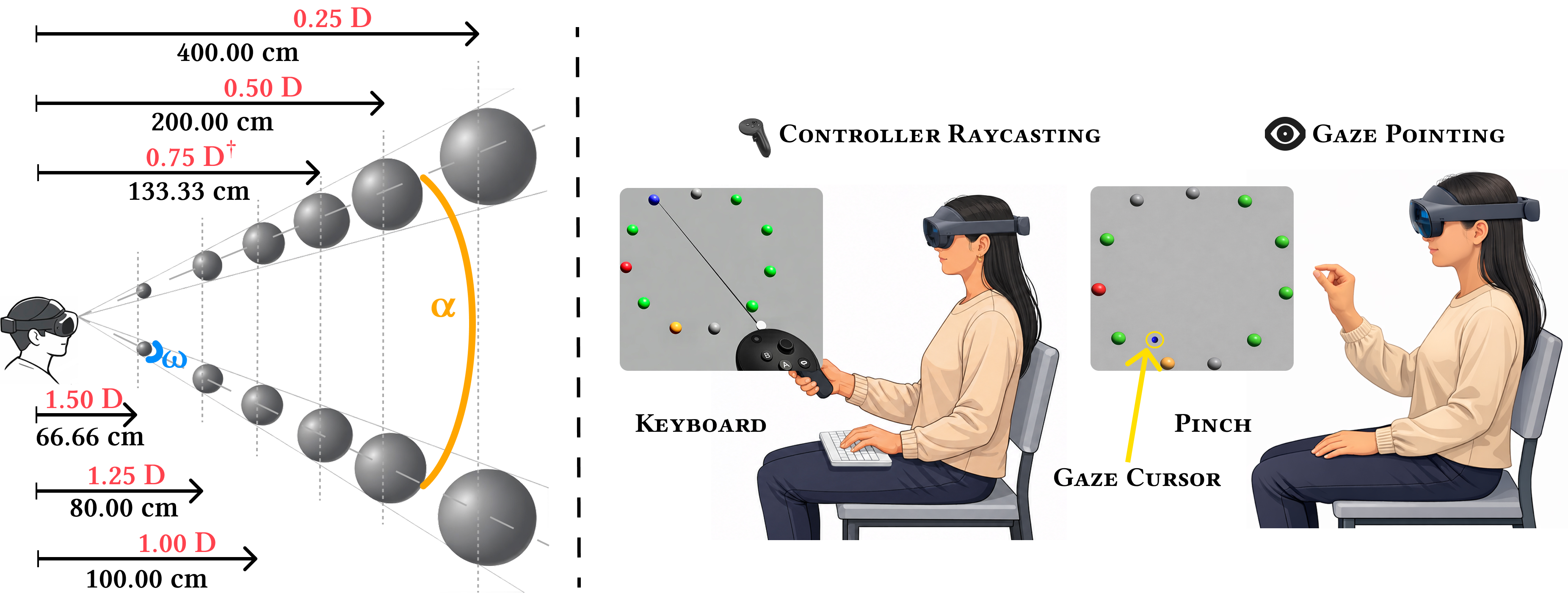
Twenty-four participants completed an ISO 9241-411 multidirectional target-selection task in a Meta Quest Pro. The within-subjects study compared gaze pointing with controller raycasting across six depth levels from 1.50 to 0.25 diopters, including targets in front of, at, and behind the headset's 0.75-diopter focal plane. The experiment recorded movement time, error rate, angular throughput, pointing variability, usability, workload, and qualitative feedback.

Overview of the user study's experimental procedure, including consent, training, task execution, and post-study questionnaires.
Results
As targets moved farther from the display's focal region, gaze movement time and error rates increased while angular throughput decreased. Gaze remained faster overall than controller raycasting, but its performance varied more strongly with depth. The Variation in Diopters model provided the strongest fit, reaching R-squared values of 0.93 for gaze and 0.84 for controller pointing.
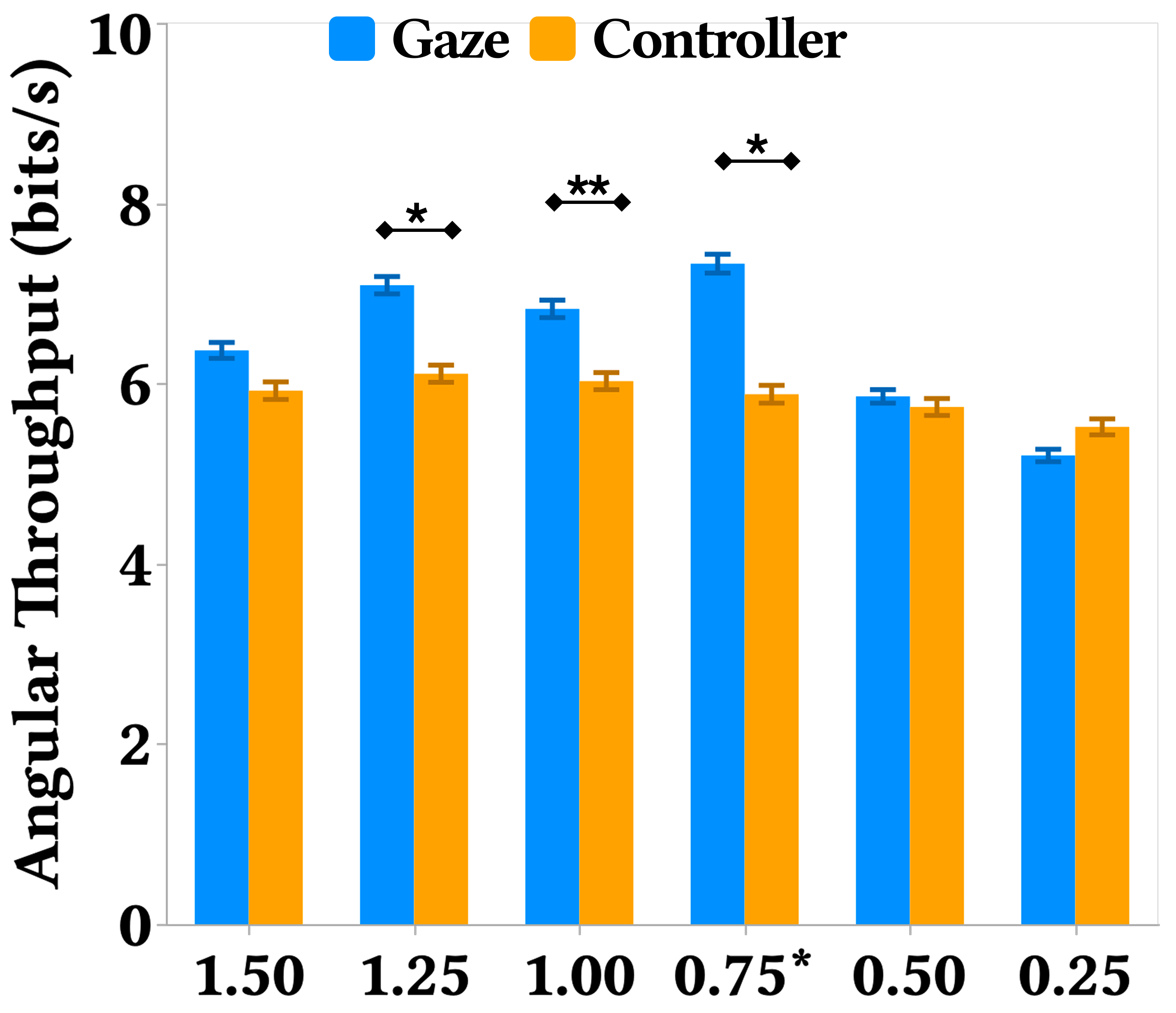
Angular throughput across depth conditions (diopters) and interaction modalities.
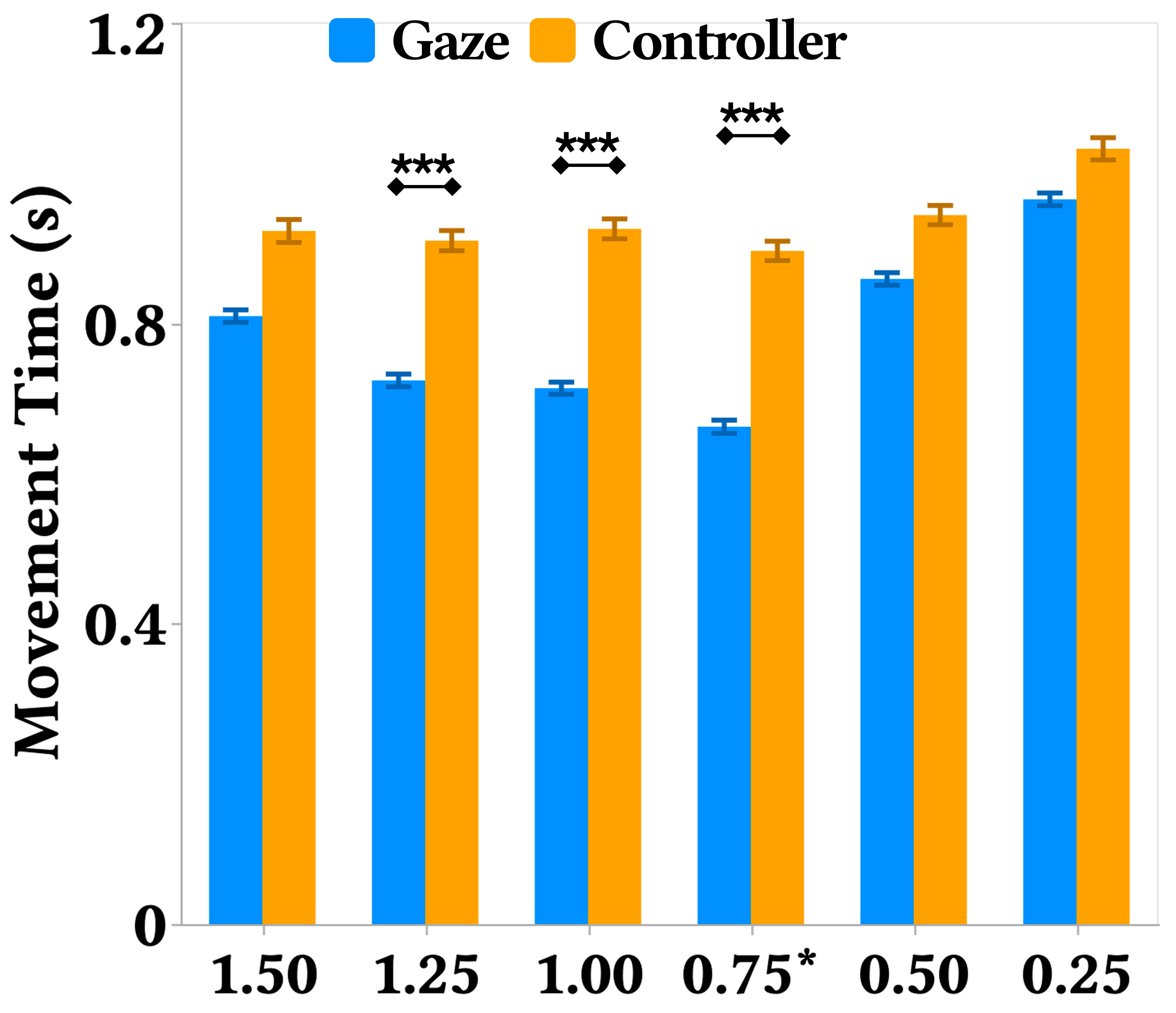
Movement time (MT) across depth conditions (diopters) and interaction modalities.
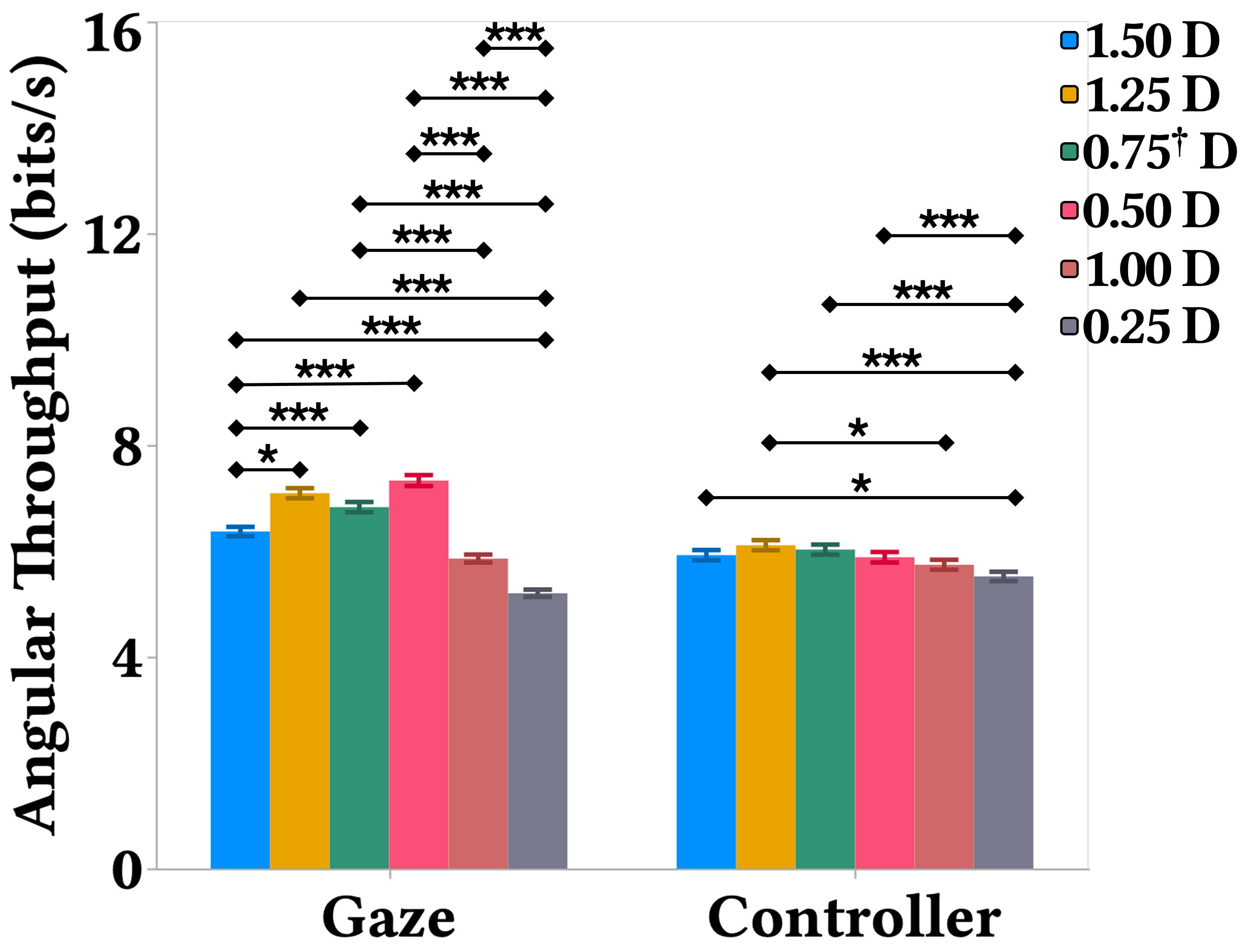
Angular throughput comparison grouped by modality.
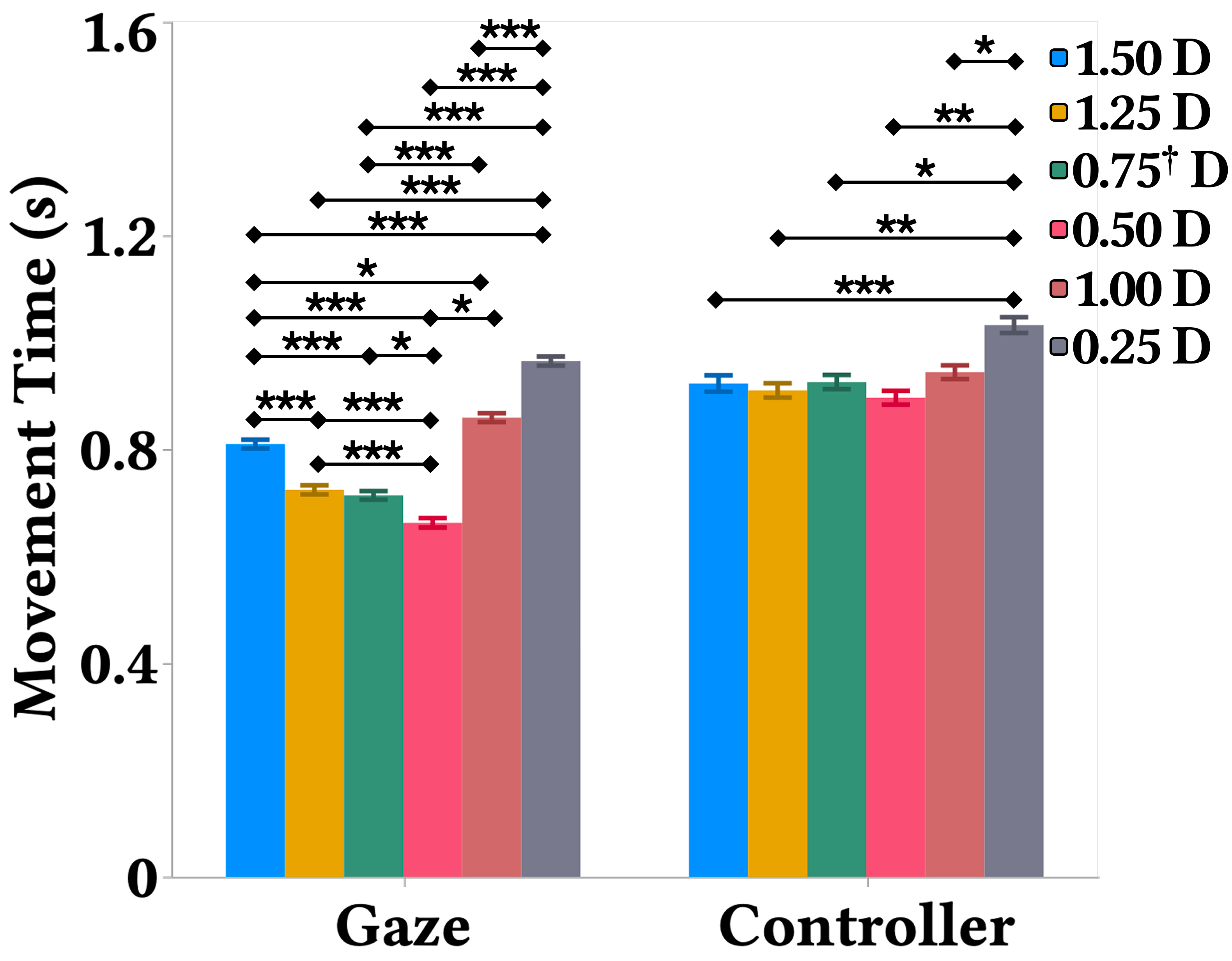
Movement time comparison grouped by modality.
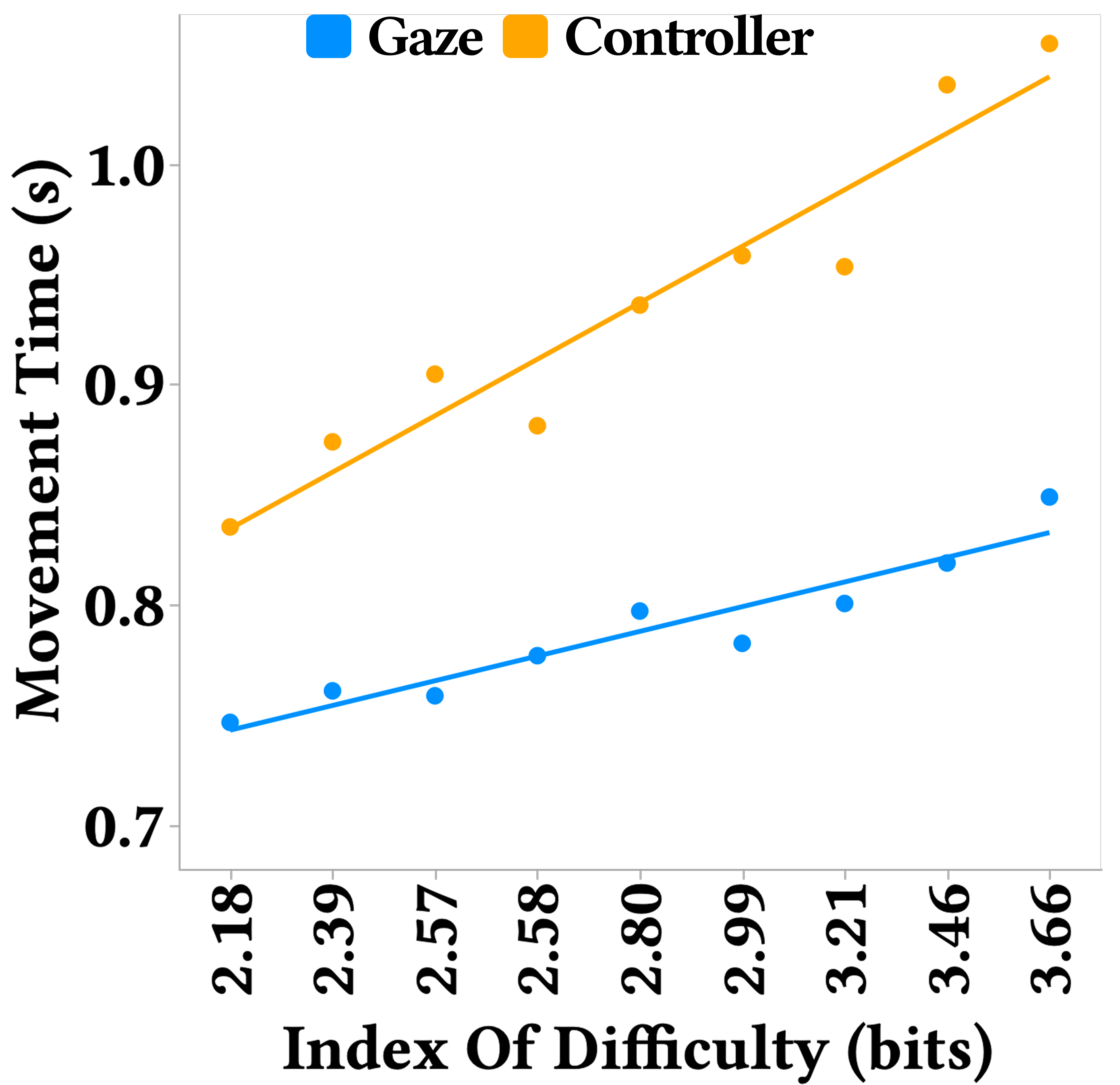
Fitts' law regression of movement time (MT) as a function of index of difficulty (ID) for GAZE and CONTROLLER.
Application & Implications
Depth-aware gaze interfaces can reduce the performance cost of the vergence-accommodation conflict by placing important targets near the focal region, stabilizing gaze input at challenging depths, and combining gaze with manual confirmation when precision is critical.
Design Guidelines:
- Place frequently used gaze targets near the headset's focal region, preferably within approximately 0.5 diopters.
- Avoid small, dense, or precision-critical gaze targets at large depth offsets.
- Use depth-aware stabilization such as filtering, target expansion, or snap-to-target assistance.
- Combine gaze acquisition with hand or controller confirmation for precision-sensitive tasks.
- Model optical depth in diopters rather than relying only on geometric distance.
BibTeX
@article{bashar2026vergence,
  author = {Bashar, Mohammad Raihanul and Amini, Mohammadreza and Mutasim, Aunnoy K and Barrera Machuca, Mayra Donaji and Stuerzlinger, Wolfgang and Batmaz, Anil Ufuk},
  title = {Evaluating the Vergence-Accommodation Conflict in Gaze-Based 3D Target Selection},
  journal = {IEEE Transactions on Visualization and Computer Graphics},
  year = {2026},
  note = {To appear; presented at IEEE ISMAR 2026}
}