Use of Spontaneous Blinking for Application in Human Authentication
Abstract
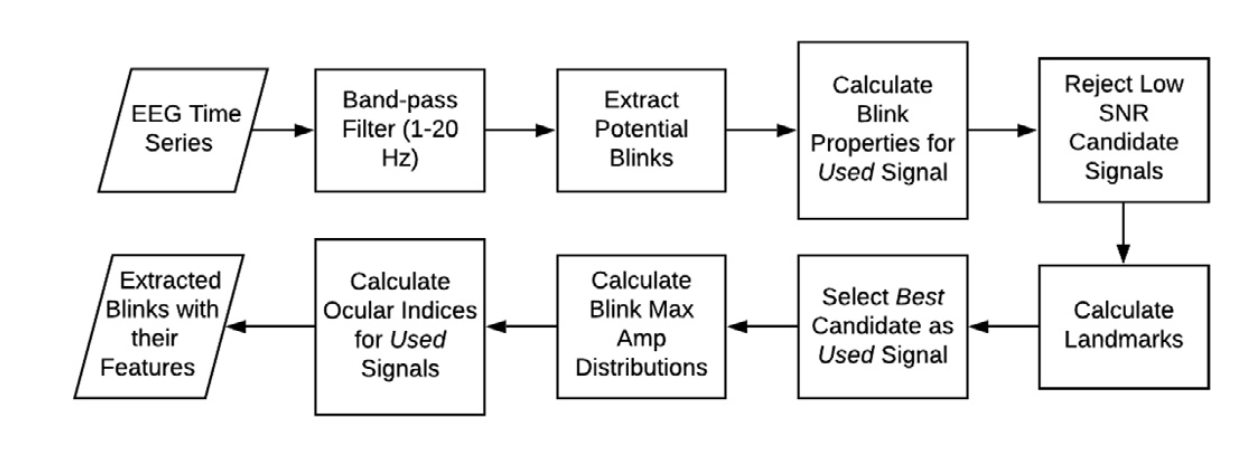
Contamination of electroencephalogram (EEG) signals due to natural blinking electrooculogram (EOG) signals is often removed to enhance EEG signal quality. This paper discusses the possibility of using solely involuntary blinking signals for human authentication. EEG data from 46 subjects were recorded while each subject viewed a sequence of pictures without focusing on any blinking task. After separating blink EOG signals from EEG, 25 features were extracted and preprocessed. Statistical analyses examined differences from prior studies of voluntary blinking. Despite testing several models, none could classify the data using only a single spontaneous blink. We therefore examined patterns in blink sequences using a Gated Recurrent Unit (GRU). Results show that individuals can be distinguished with up to 98.7% accuracy using a reasonably short sequence of involuntary blinking signals.
BibTeX
@article{jalilifard2020use,
  author = {Jalilifard, Amir and Chen, Dehua and Mutasim, Aunnoy K. and Bashar, Mohammad Raihanul and Tipu, Rayhan Sardar and Shawon, Ahsan-Ul Kabir and Sakib, Nazmus and Amin, M. Ashraful and Islam, Md Kafiul},
  title = {Use of Spontaneous Blinking for Application in Human Authentication},
  journal = {Engineering Science and Technology, an International Journal},
  volume = {23},
  number = {4},
  pages = {903--910},
  year = {2020},
  doi = {10.1016/j.jestch.2020.05.007}
}