There Is More to Dwell Than Meets the Eye: Toward Better Gaze-Based Text Entry Systems With Multi-Threshold Dwell


Abstract
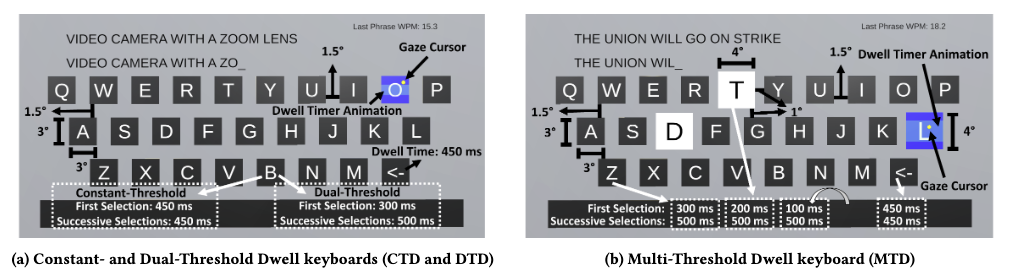
Dwell-based text entry seems to peak at 20 words per minute (WPM). Yet, little is known about the factors contributing to this limit, except that it requires extensive training. Thus, we conducted a longitudinal study, broke the overall dwell-based selection time into six different components, and identified several design challenges and opportunities. Subsequently, we designed two novel dwell keyboards that use multiple yet much shorter dwell thresholds: Dual-Threshold Dwell (DTD) and Multi-Threshold Dwell (MTD). The performance analysis showed that MTD (18.3 WPM) outperformed both DTD (15.3 WPM) and the conventional Constant-Threshold Dwell (12.9 WPM). Notably, absolute novices achieved these speeds within just 30 phrases. Moreover, MTD's performance is also the fastest-ever reported average text entry speed for gaze-based keyboards. Finally, we discuss how our chosen parameters can be further optimized to pave the way toward more efficient dwell-based text entry.
Methodology
We conducted a 2-stage investigation: first, an 8-day longitudinal VR study decomposing dwell selection time into six distinct sub-components (Exit Time, Pointing Time, On Target Time, Drop-off Time, Activation Time, Total Time); second, a controlled evaluation comparing conventional CTD against novel Dual-Threshold Dwell (DTD) and Multi-Threshold Dwell (MTD) keyboards.
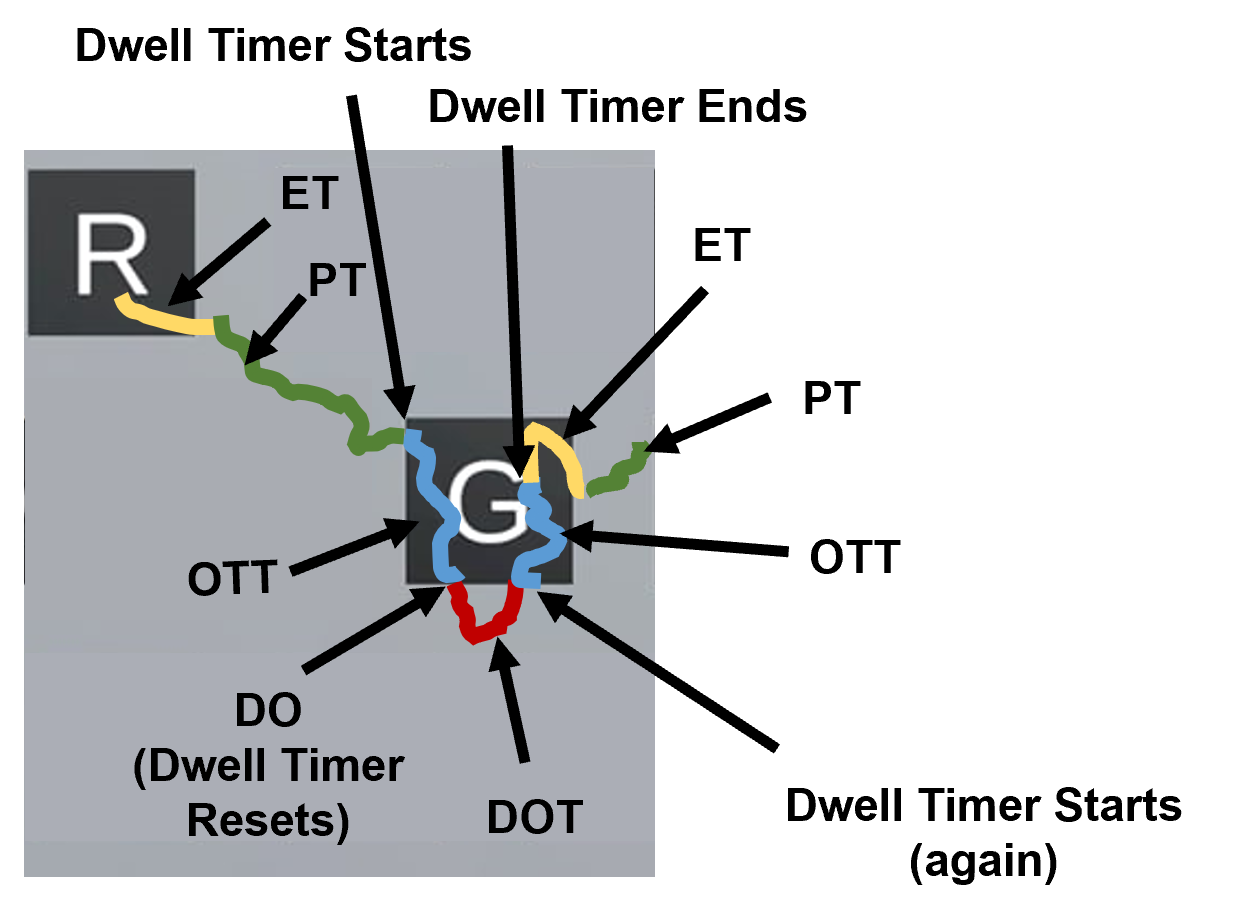
Granular breakdown of dwell selection time components: Exit Time (ET), Pointing Time (PT), On Target Time (OTT), Drop-off Time (DOT), and Drop-offs (DOs).
Results
Multi-Threshold Dwell (MTD) achieved 18.3 WPM with novice users in just 30 phrases, significantly outperforming Dual-Threshold Dwell (15.3 WPM) and conventional Constant-Threshold Dwell (12.9 WPM). MTD is the fastest gaze-based keyboard reported in the literature.
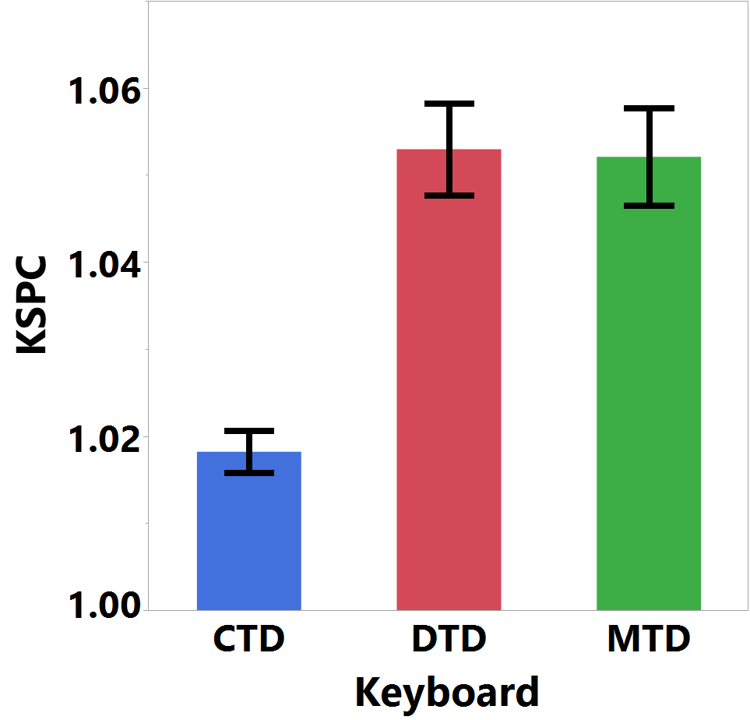
Keystrokes per character (KSPC) across Constant-Threshold (CTD), Dual-Threshold (DTD), and Multi-Threshold Dwell (MTD) keyboards.
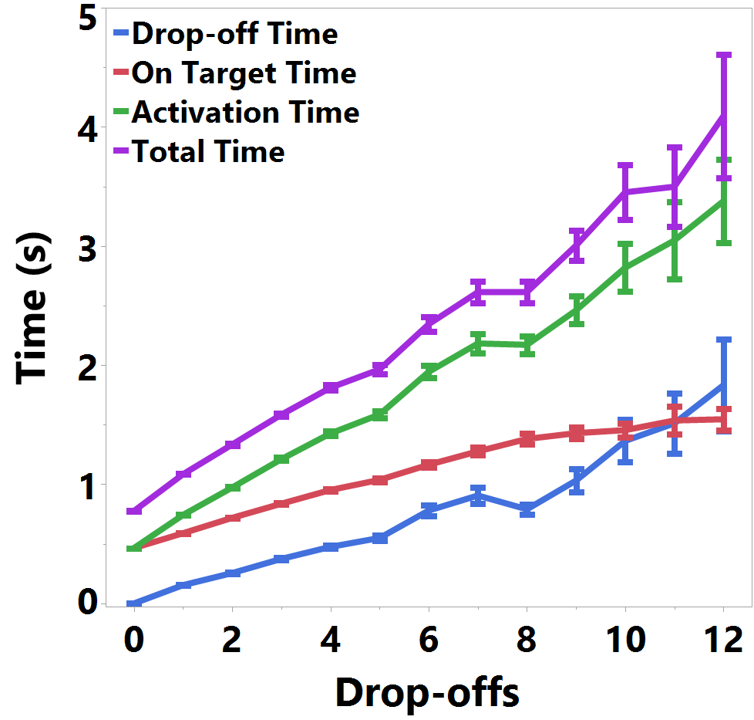
Study 1 dwell selection time components (OTT, DOT, AT, TT) over number of drop-offs.
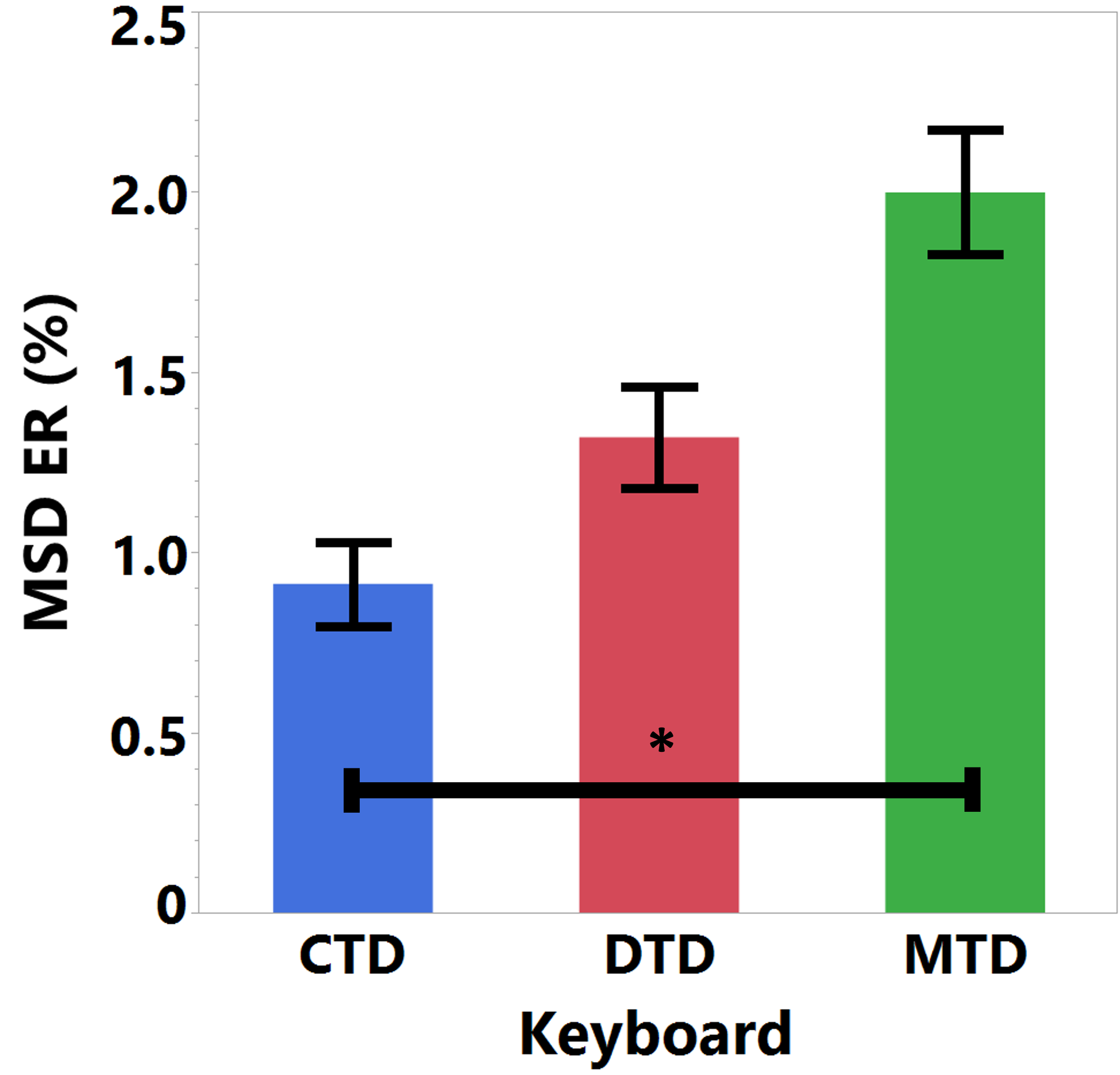
Overall Minimum String Distance Error Rate (MSD ER) across CTD, DTD, and MTD keyboards.
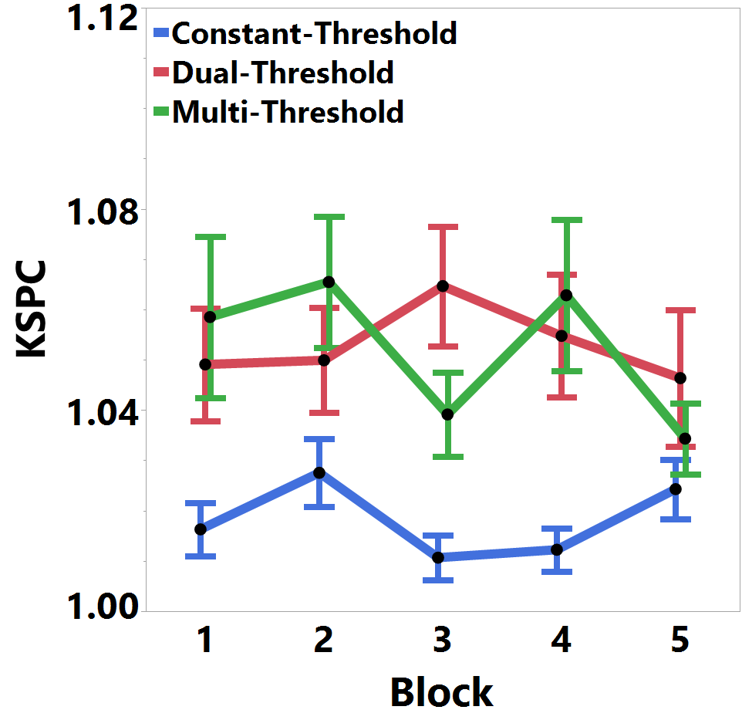
KSPC across experimental blocks for CTD, DTD, and MTD keyboards.
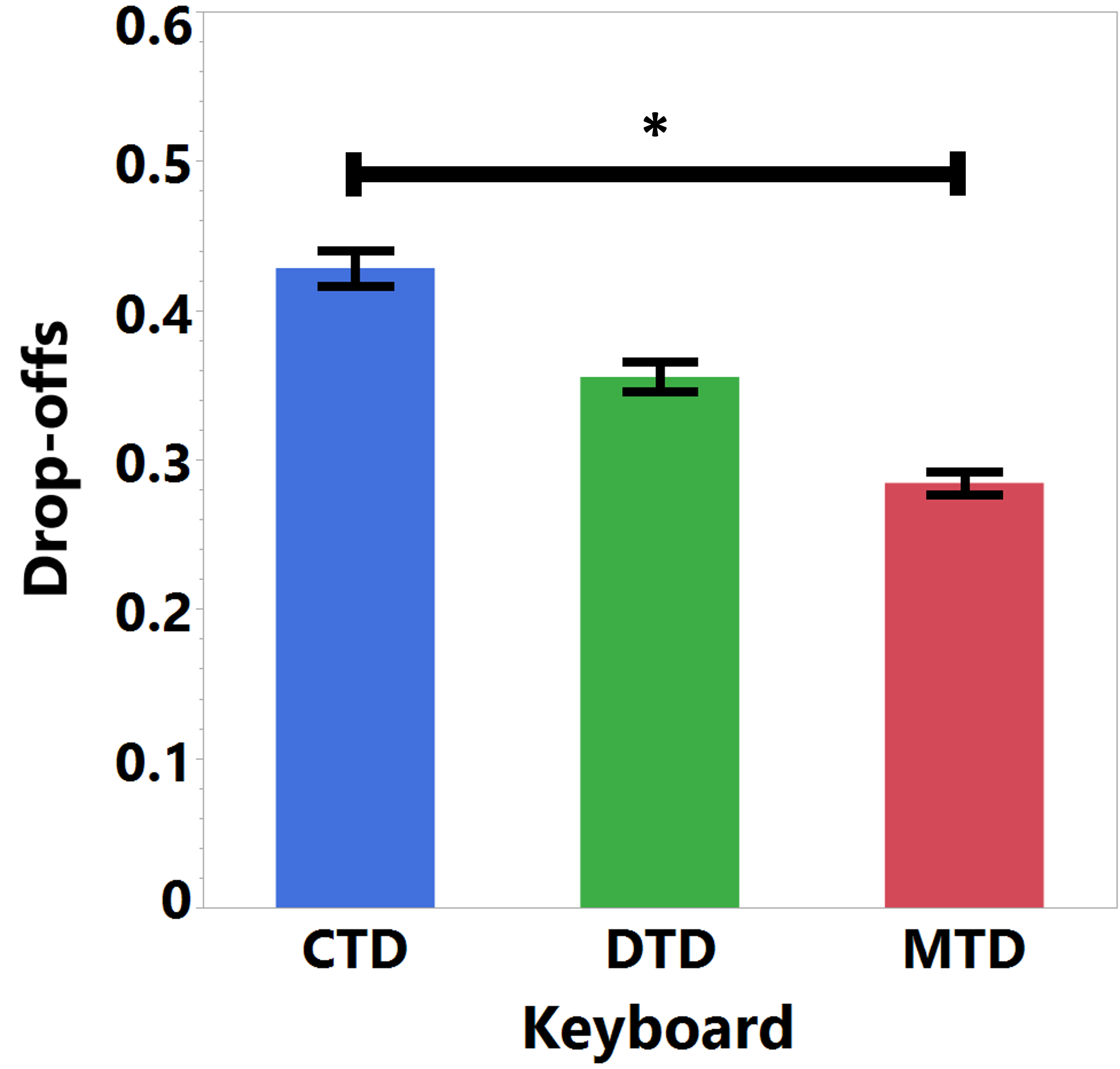
Average number of drop-offs (DOs) across keyboard conditions.
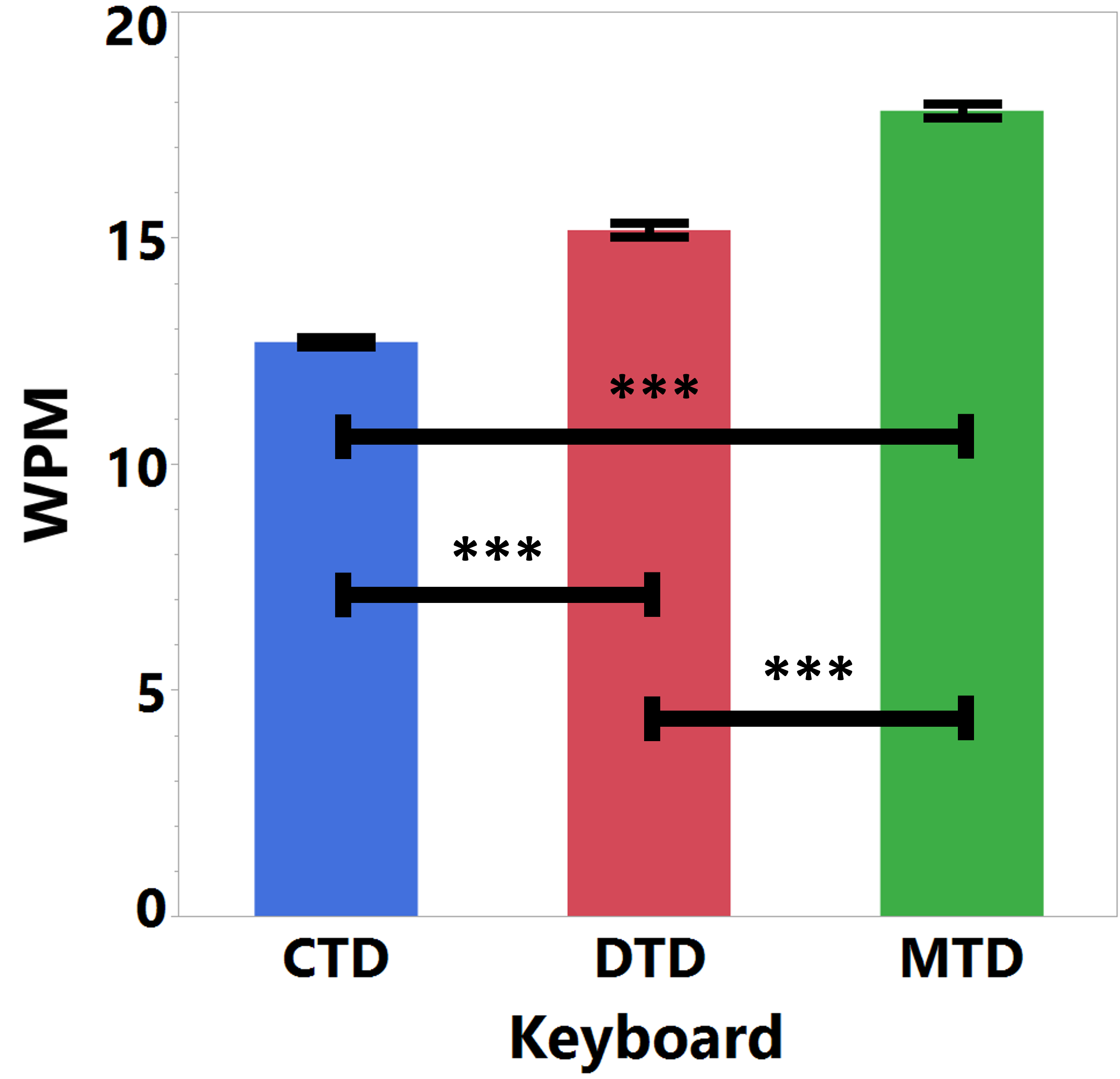
Overall text entry speed (WPM) across CTD (12.9 WPM), DTD (15.3 WPM), and MTD (18.3 WPM) keyboards.
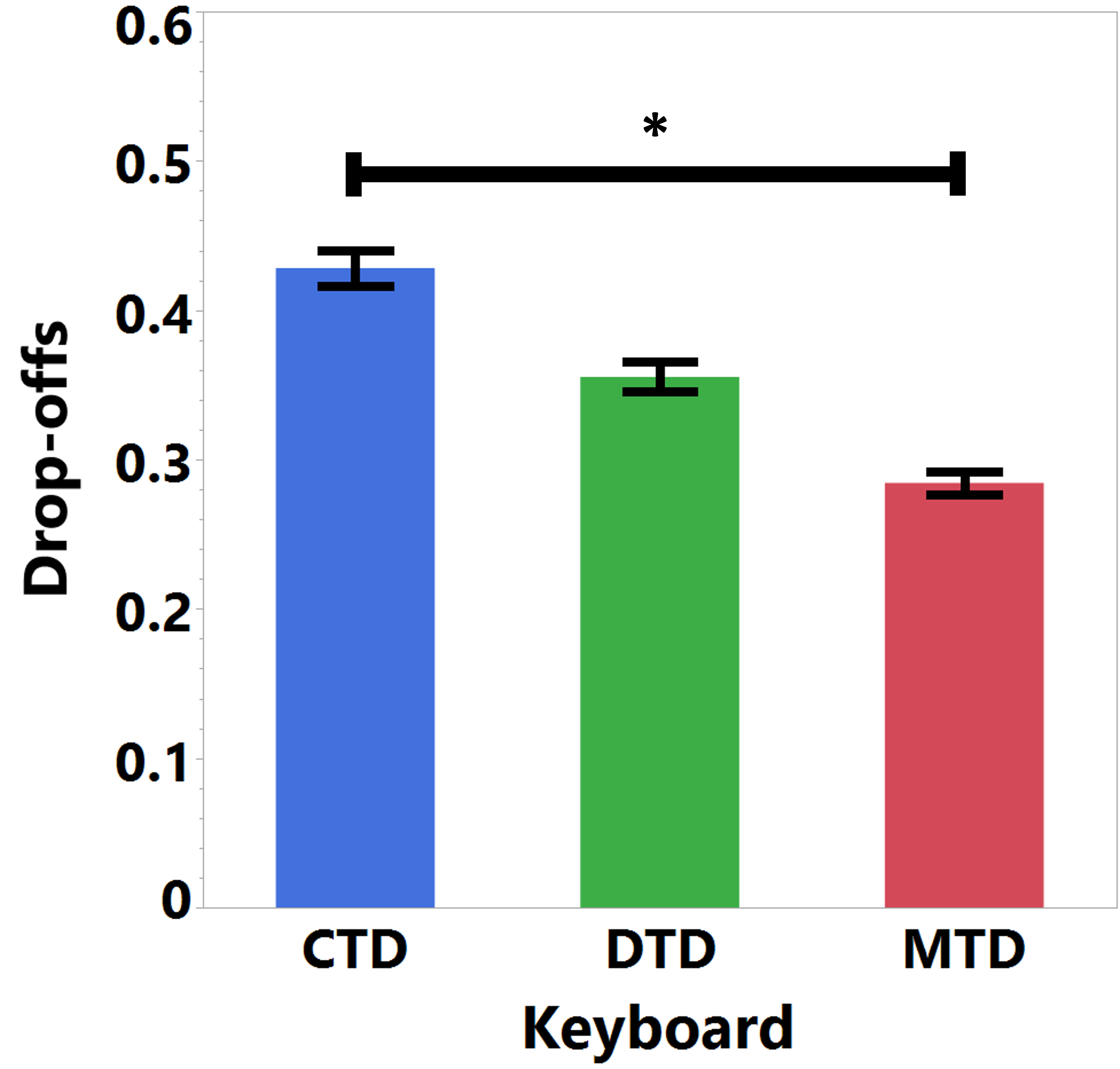
Drop-offs (DOs) breakdown across CTD, DTD, and MTD keyboards.
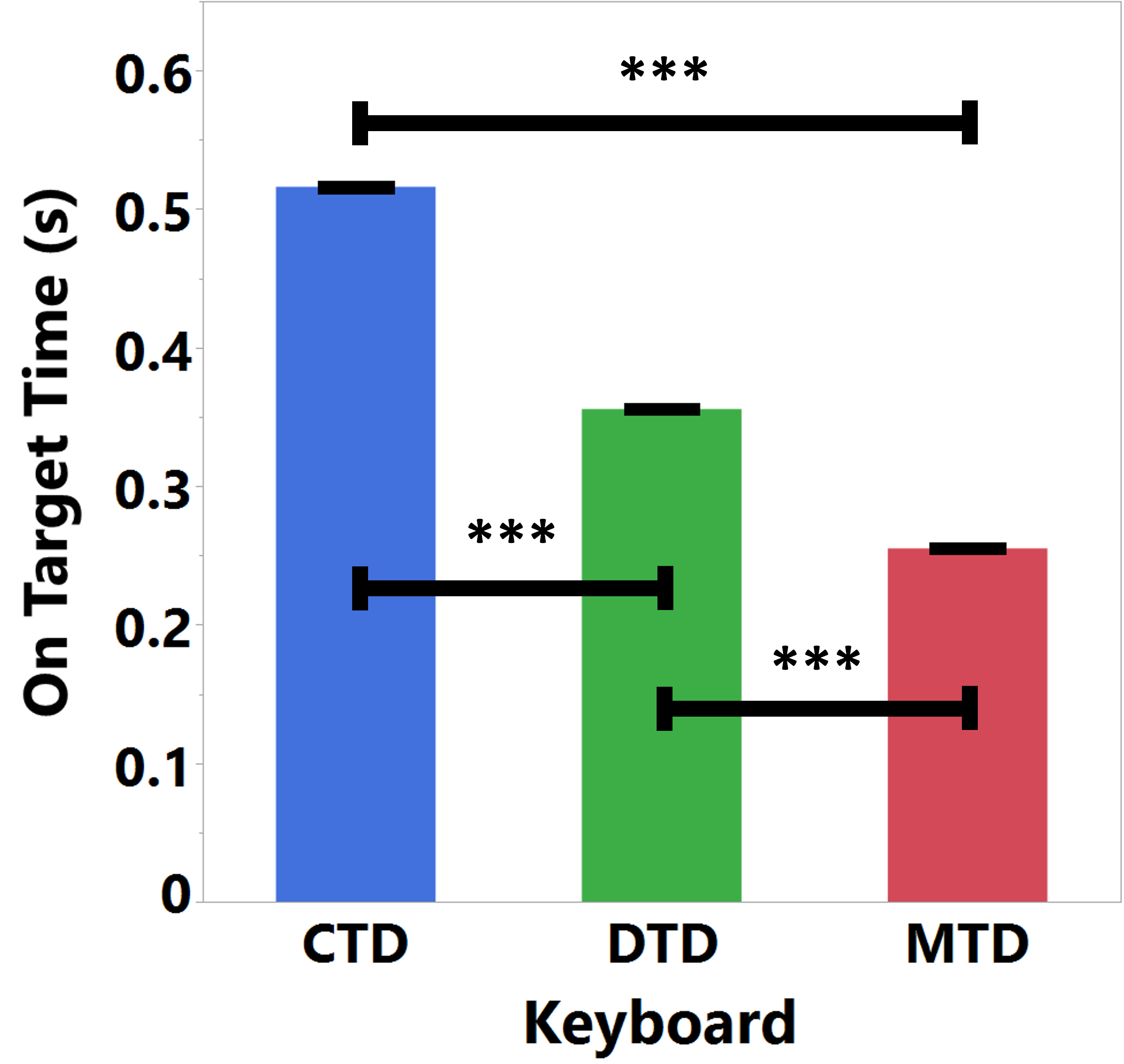
On Target Time (OTT) comparison across dwell keyboards.
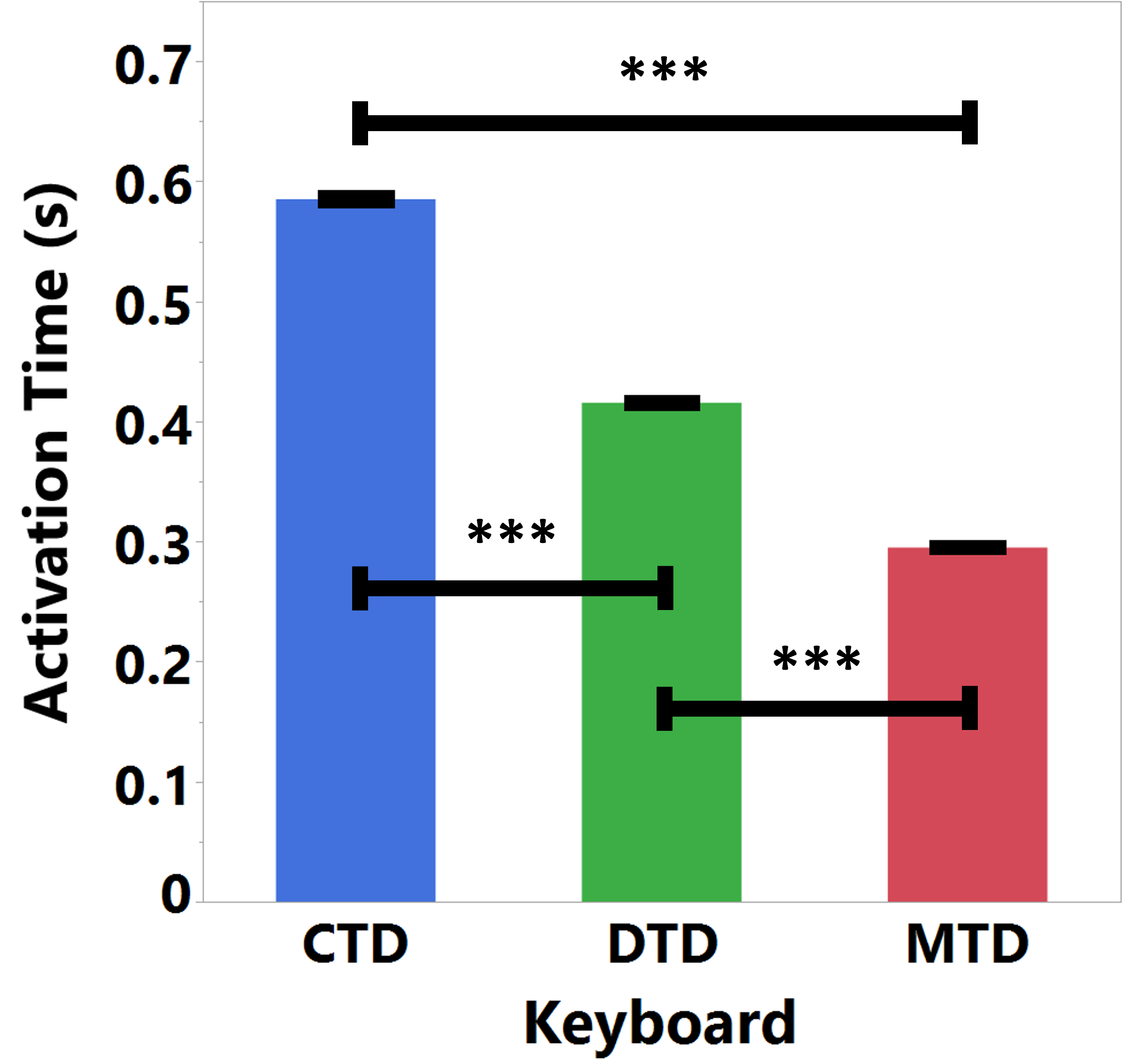
Activation Time (AT) comparison across dwell keyboards.
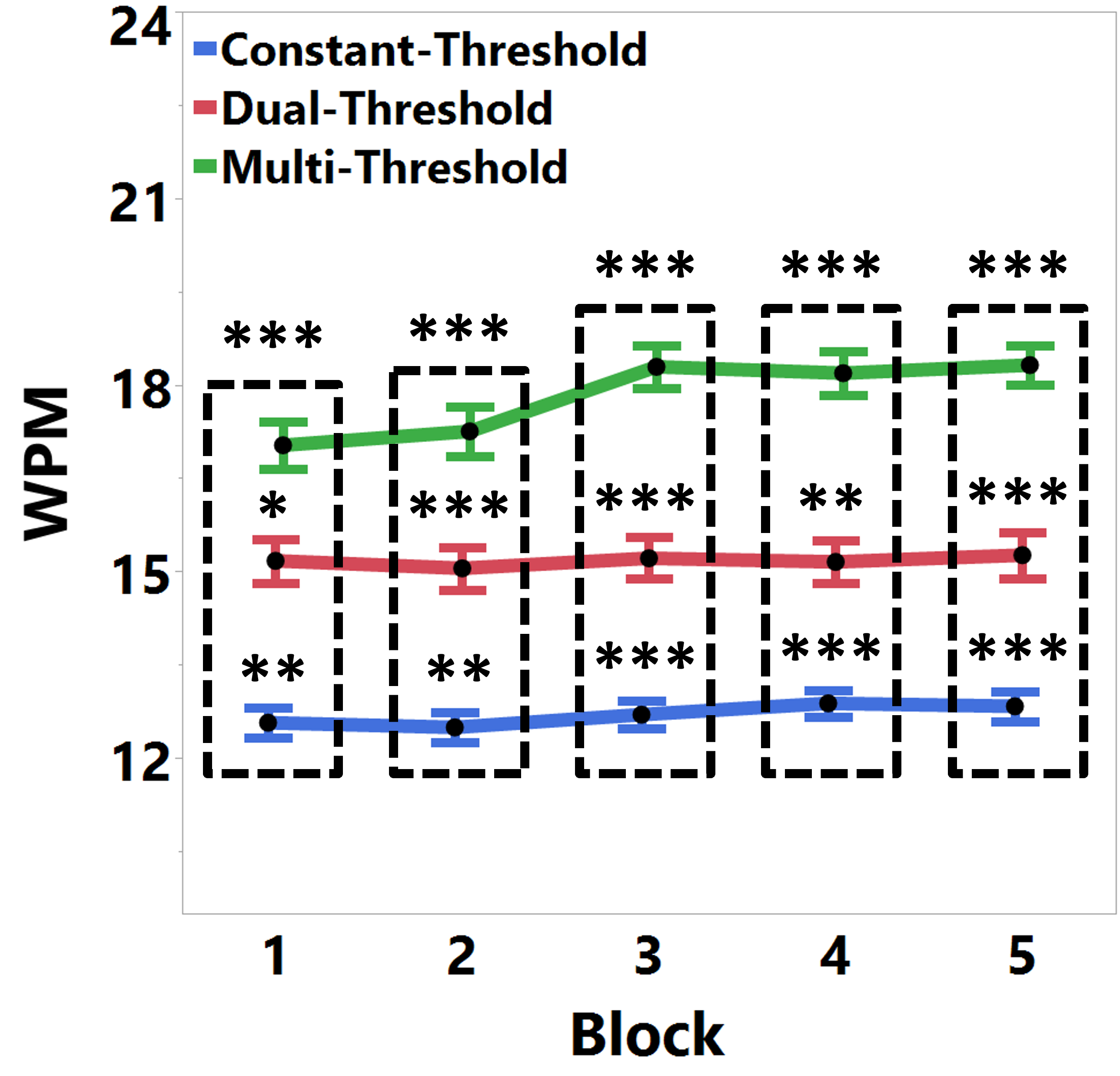
Text entry speed (WPM) across experimental blocks showing rapid learnability of MTD.
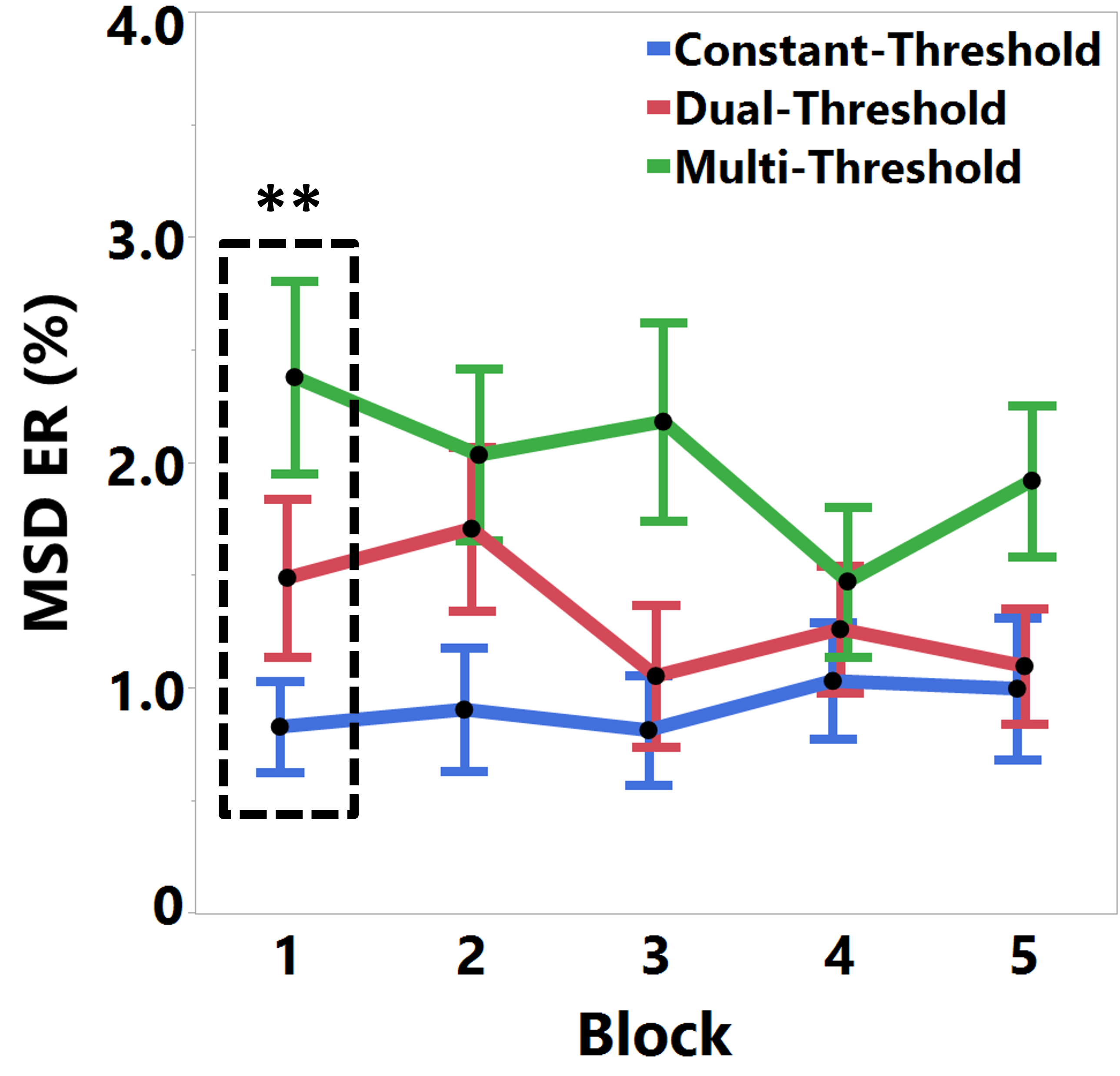
MSD Error Rate across experimental blocks for CTD, DTD, and MTD keyboards.
Presentation
Application & Implications
Multi-threshold dwell strategies enable fast, fluid hands-free gaze typing in immersive virtual reality environments without requiring extensive training or introducing high error rates.
Design Guidelines:
- Adjust dwell thresholds based on letter prediction to accelerate common text entry sequences while preventing unintentional double clicks.
- Enlarge and highlight predicted target keys to facilitate rapid visual acquisition during eye-gaze typing.
BibTeX
@inproceedings{mutasim2025there,
  author = {Mutasim, Aunnoy K. and Bashar, Mohammad Raihanul and Lutteroth, Christof and Batmaz, Anil Ufuk and Stuerzlinger, Wolfgang},
  title = {There Is More to Dwell Than Meets the Eye: Toward Better Gaze-Based Text Entry Systems With Multi-Threshold Dwell},
  booktitle = {Proceedings of the 2025 CHI Conference on Human Factors in Computing Systems},
  series = {CHI '25},
  articleno = {1088},
  numpages = {18},
  year = {2025},
  doi = {10.1145/3706598.3713781}
}